



The Donation Experience
- What You Can Expect
- The Donation Process
- The Screening Process
- Confidential Unit Exclusion Label
- The Record of Donation (Questionnaire)
- New Donor Contact Information
1. What You Can Expect
Including time for screening and recovery, the process of making a blood donation takes about one hour.
- Proof of identity, such as a valid driver’s license or blood donor card, is required.
- The screening process includes the completion of a questionnaire and interview process.
- During the entire process, steps are taken to ensure that the donation process is as safe and comfortable as possible.
- You should have had something to eat and drink in the hours prior to donating as well as adequate sleep. If you are hungry or thirsty at the time of your blood donation, you may be at slightly increased risk of experiencing a reaction to donating. You must also meet hemoglobin (iron) requirements (hemoglobin test done at clinic).
- Your hemoglobin, blood pressure and temperature are checked.
- Only new, sterile equipment is used during the donation process.
- Most people feel well while giving blood and give regularly without incident.
- Some people may feel faint, weak or nauseous during or after donation.
- Some people may get a small bruise, some redness or moderate pain at the needle site.
- Very rarely will people faint, have muscle spasms or suffer nerve damage.
- You cannot get a transmissible disease by donating blood in Canada.
After donating, you are taken to a refreshment area and are provided with food and beverages to boost your blood sugar level. Avoid strenuous physical activity for about six to eight hours after you give.
/\ Top
2. The Donation Process
Whole blood donations can be made at your local Canadian Blood Services location or at any of the thousands of mobile clinics held each year. The entire process including registration, screening, donation and recovery takes about one hour. The process is as follows:
- Donors are required to register with Canadian Blood Services by providing a proof of identity such as a valid driver’s license or blood donor card.
- Donors are required to complete a screening process that includes:
- If a donor does not meet all of the minimum eligibility requirements to donate blood (e.g., low hemoglobin, certain medical conditions, participation in high-risk activities, etc.) the employee will explain that a temporary or indefinite deferral is necessary and the process ends.
- If the donor is able to donate, the donor is required to sign and date an informed consent form on the Donation Questionnaire, indicating that they have answered all of the questions truthfully.
The donor is taken into the donation area and the arm is swabbed with a disinfecting agent for one full minute, to ensure sterility of the venepuncture site. For each donation, a new, sterile needle is used, then safely disposed. Sterile gauze is applied once the needle is removed.
- After the donation is complete, a nurse asks if the donor is feeling all right. An attendant then leads the donor to a comfortable chair for recovery where the donor is monitored for five minutes.
- The donor is taken into the refreshment area and is provided with food and beverages to boost their blood sugar level. If the clinic is appointment-based, donors can book their next appointment.
/\ Top
3. The Screening Process
The screening process ensures the safety of the donor during the process of giving blood, and protects the blood supply from the least possible risk of a transmissible disease, Canadian Blood Services engages in the strictest of donor screening activities.
The screening process involves physical tests and the completion of a questionnaire on general health, travel history and high-risk activities. Canadian Blood Services donor screening policies are consistent with the guidelines of Health Canada’s Biologics and Genetic Therapies Directorate, the United States Food and Drug Administration, and the American Association of Blood Banks.
The process is as follows:
- The donor is required to provide a proof of identity. This information is recorded on the Record of Donation.
- A hemoglobin test is performed to ensure the donor’s iron level is sufficient for donation.
- The donor is required to review general information on high-risk activities, the donation process and post-donation information and to make a decision whether it is appropriate to donate or not.
- The donor answers questions 1 through 13 on the Record of Donation.
- The donor’s blood pressure and temperature is checked to ensure the safety of the donor during donation.
- The donor’s arms are checked for signs of intravenous drug use.
- The screening Canadian Blood Services employee reviews questions 1 through 13 and questions 14 through 30 are asked aloud, with all answers recorded on the Record of Donation.
- If any of the test results or interview answers indicate a deferral is necessary, the Canadian Blood Services employee explains this and the process ends.
- The donor signs an informed consent on the Record of Donation questionnaire, verifying that all questions have been answered truthfully.
- The donor is provided with two bar codes that constitute the Confidential Unit Exclusion Label. This procedure allows the donor one last chance, with complete confidentiality, to say that his/her blood should not be used.
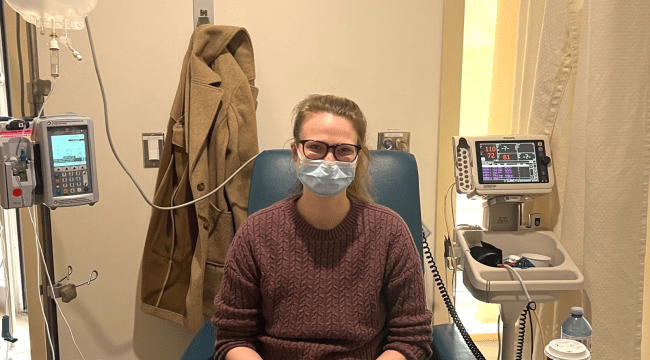
(Donor Experience photos are of Winnipeg donor, Richard Jones.)
/\ Top
Confidential Unit Exclusion Label
There may be circumstances where a donor may not answer the Record of Donation questionnaire truthfully. In some cases, owing to the personal nature of the questions, a donor may be uncomfortable with providing certain pieces of information. In other cases, donors may be reluctant to tell friends, family or colleagues that they have been deferred—and thus continue with the donation to avoid answering uncomfortable questions.
To guard against such situations, the Canadian Blood Services employee provides the donor with two bar-coded labels. One indicates that the donor’s blood can be used and the other asks that the blood not be used. Once the appropriate sticker has been placed on the Record of Donation, no one at the clinic can determine which one was chosen. It is only later, in the laboratory, that a technician will scan the label with a bar-code reader before the unit is processed to determine whether or not it may be used.